There’s an old saying that dogs have owners and cats have staff. Having photographed plenty of both, I can confirm there’s a reasonable amount of truth to that.
Dogs will often do something because you’ve asked them nicely and there’s a piece of cheese involved. Cats, on the other hand, tend to approach the entire situation as a negotiation in which they hold all the cards.
So when people see my studio portraits of cats, one of the first things they ask is how on earth I get them to cooperate.
The answer is that I don't necessarily expect them to.
Photographing cats is less about teaching them to pose and more about understanding their natural behaviour, creating an environment where they feel comfortable and knowing how to work with whatever they decide to give you.
And occasionally convincing them that the whole thing was their idea.

Yuki
Cats are not small dogs
This might seem fairly obvious, but it's probably the most important thing to understand about photographing cats.
Dogs have been selectively bred over thousands of years to work alongside humans in all sorts of roles, and many are naturally inclined to respond to our cues and instructions. Cats have a rather different relationship with us, and their behaviour, motivations and responses to unfamiliar situations reflect that.
Trying to photograph a cat using exactly the same approach you'd use for a dog is a pretty reliable way to end up frustrated. The cat, meanwhile, will probably be completely unbothered by your disappointment.
Instead, I pay attention to what the cat naturally wants to do. Are they curious about their surroundings? Do they enjoy playing? Are they confident enough to explore, or would they prefer to observe everything from somewhere they feel secure?
Understanding those things gives me a much better starting point than expecting them to sit on command and look directly into the camera.
The aim isn't to make a cat behave like a dog. It's to create beautiful photographs of a cat being wonderfully, unmistakably cat.
The studio environment makes a difference
Cats are particularly sensitive to changes in their environment, so bringing them into an unfamiliar photography studio needs to be handled thoughtfully.
Some cats are confident explorers who will emerge from their carrier and immediately begin inspecting the premises. Others would prefer to stay somewhere familiar until they've had a chance to assess the situation.
Neither response is unusual, and neither tells me that a cat will or won't photograph well.
At Frog Dog Studios, every experience begins with an in studio consultation. This gives me an opportunity to meet your cat, learn about their personality and see how they respond to the space before we plan their photography session.
We'll talk about how they behave at home, what they enjoy, whether they're comfortable being handled and anything that might make them anxious. I'll also want to know how they cope with travelling, because for some cats, the car journey is a much bigger concern than anything that happens once they arrive.
A cat who is relaxed and confident in their own home may behave very differently somewhere unfamiliar. That's why it's important to consider the individual animal rather than assuming every cat will settle in the same way.
And if your cat would prefer to remain in their carrier for a while and observe proceedings from a safe distance, that's perfectly fine. We're not going to drag them out and announce that their modelling career starts immediately.
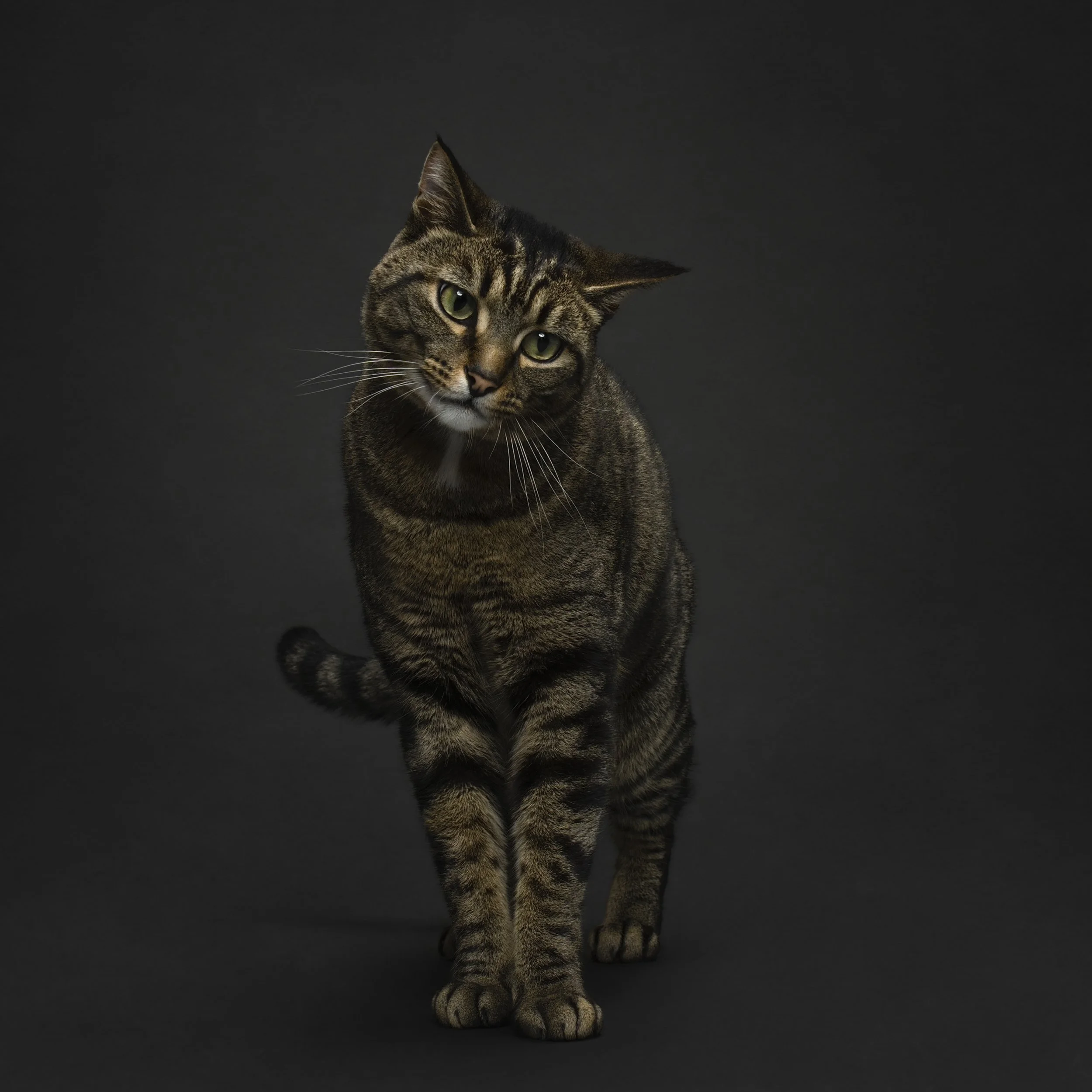
King Julien
Curiosity is one of my favourite tools
One of the wonderful things about photographing cats is that curiosity can be an incredibly useful way to create expressions and movement.
A feather toy moving just outside the frame might encourage a cat to look in a particular direction. A small sound can sometimes produce that lovely alert expression, with ears forward and eyes focused. For playful cats, a toy can help create movement and poses that would be almost impossible to achieve by asking them to sit still.
The trick is to work with their natural responses rather than constantly trying to redirect them.
Cats are also very good at deciding when they've had enough of something. A toy that was apparently the most fascinating object in the universe thirty seconds ago can suddenly become completely irrelevant.
When that happens, there's not much point continuing to wave it around like a deranged air traffic controller. We change what we're doing and find something else that interests them.
I also pay close attention to their body language. A cat who is alert and engaged is very different from one who is becoming overwhelmed or defensive. Ears, eyes, posture, tail movement and the overall situation all help me understand whether they're comfortable with what we're doing.
Those observations guide the session just as much as the photographs I'm hoping to create.
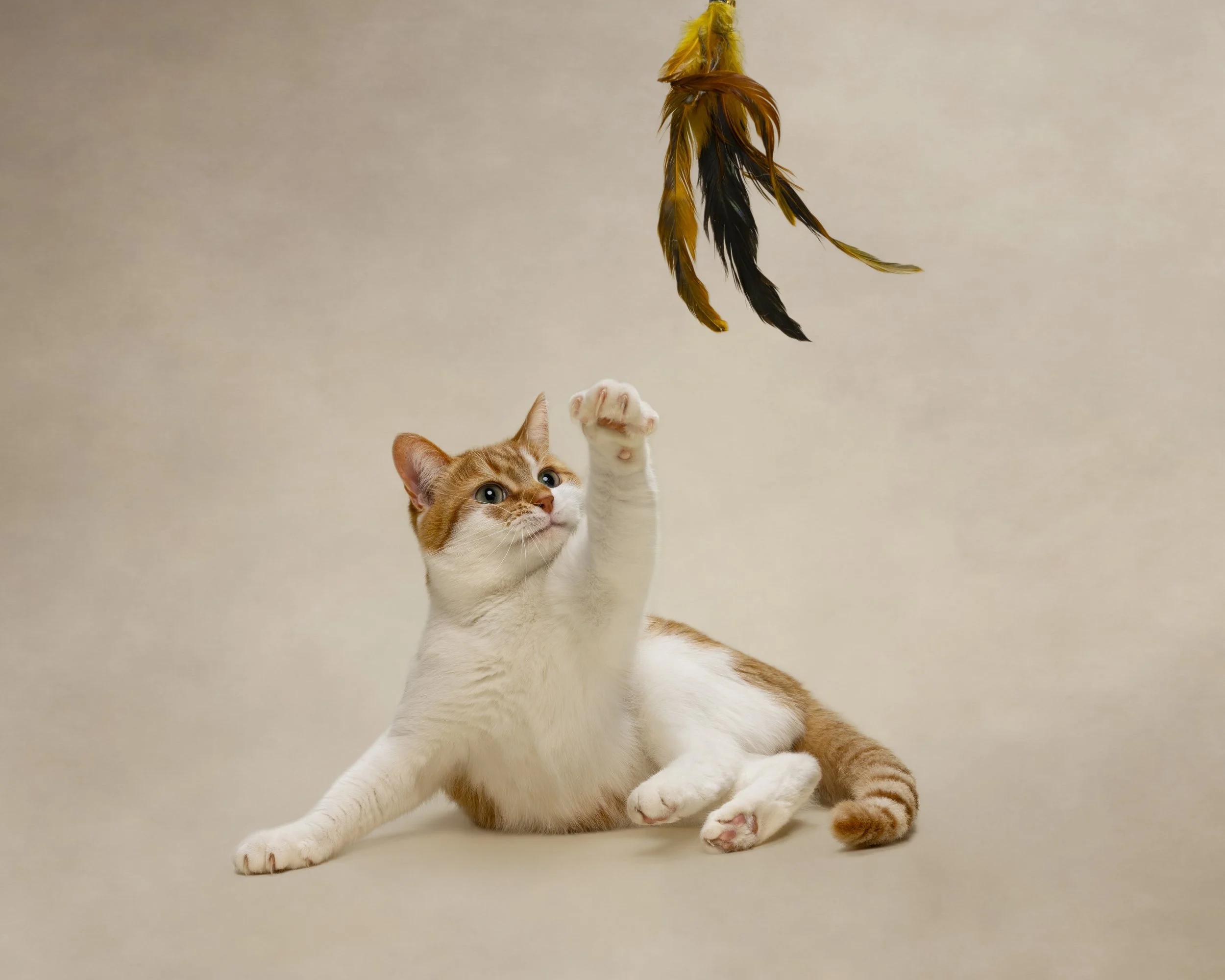
Finn
How do you get a cat to look at the camera?
This is where things can get entertaining.
A cat doesn't necessarily understand why I want them to look in a particular direction, and they certainly don't care that the lighting would be absolutely perfect if they'd just turn their head another two centimetres.
Rather than repeatedly calling their name, I'll often use a small movement or sound to attract their attention at exactly the right moment.
Timing is particularly important because cats can move from a beautifully alert expression to complete indifference remarkably quickly. I need to be watching for the moment their eyes engage, their ears come forward and their head turns into the light.
Sometimes that moment lasts long enough for several photographs. Other times I get one frame before the cat decides something happening on the other side of the room is considerably more interesting.
Fortunately, one frame can be enough.
And sometimes the best expression isn't one where the cat is looking directly at the camera at all. A sideways glance, a suspicious stare or that wonderfully superior expression cats do so well can tell us far more about their personality.
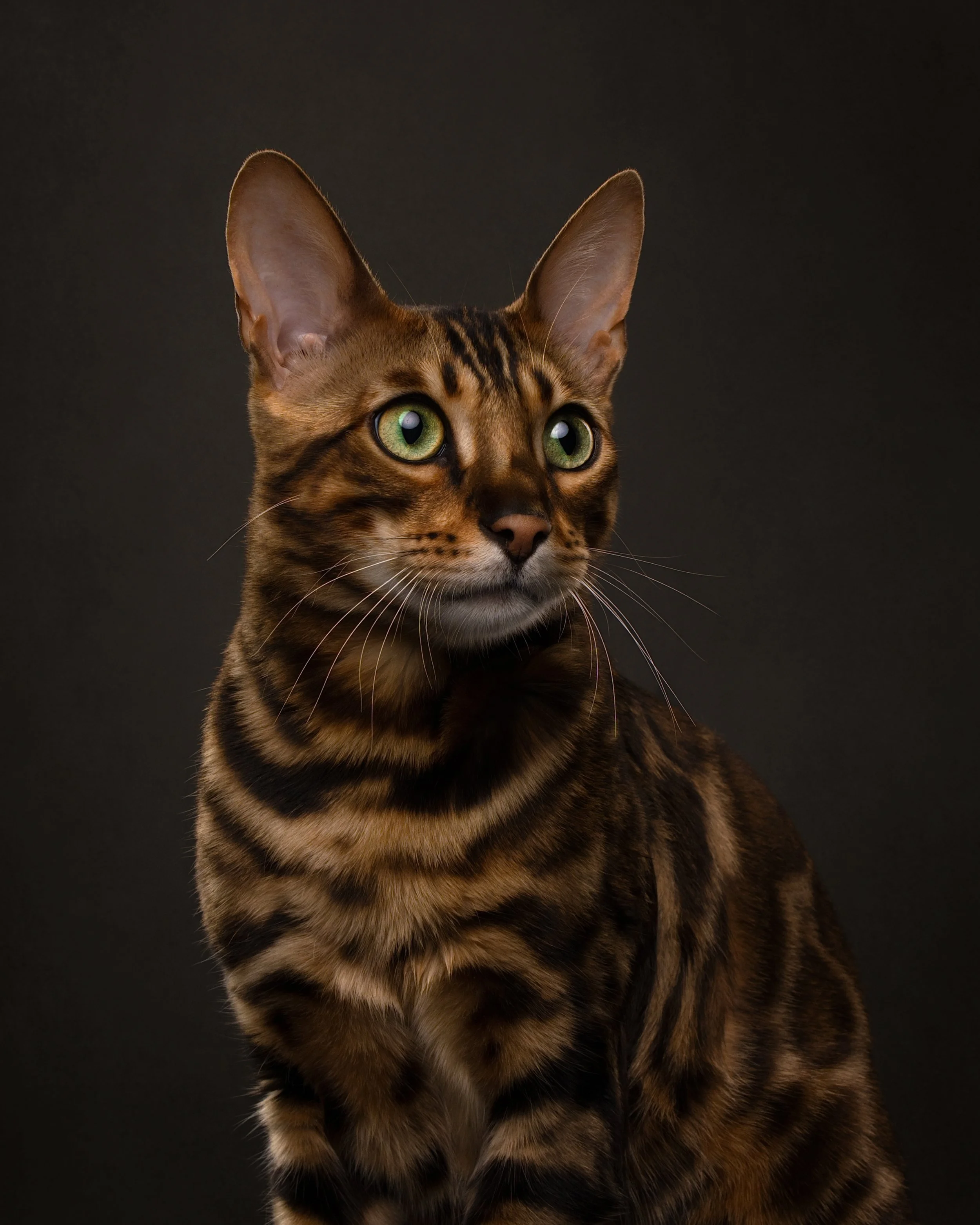
Toffee goes from glam to goof.
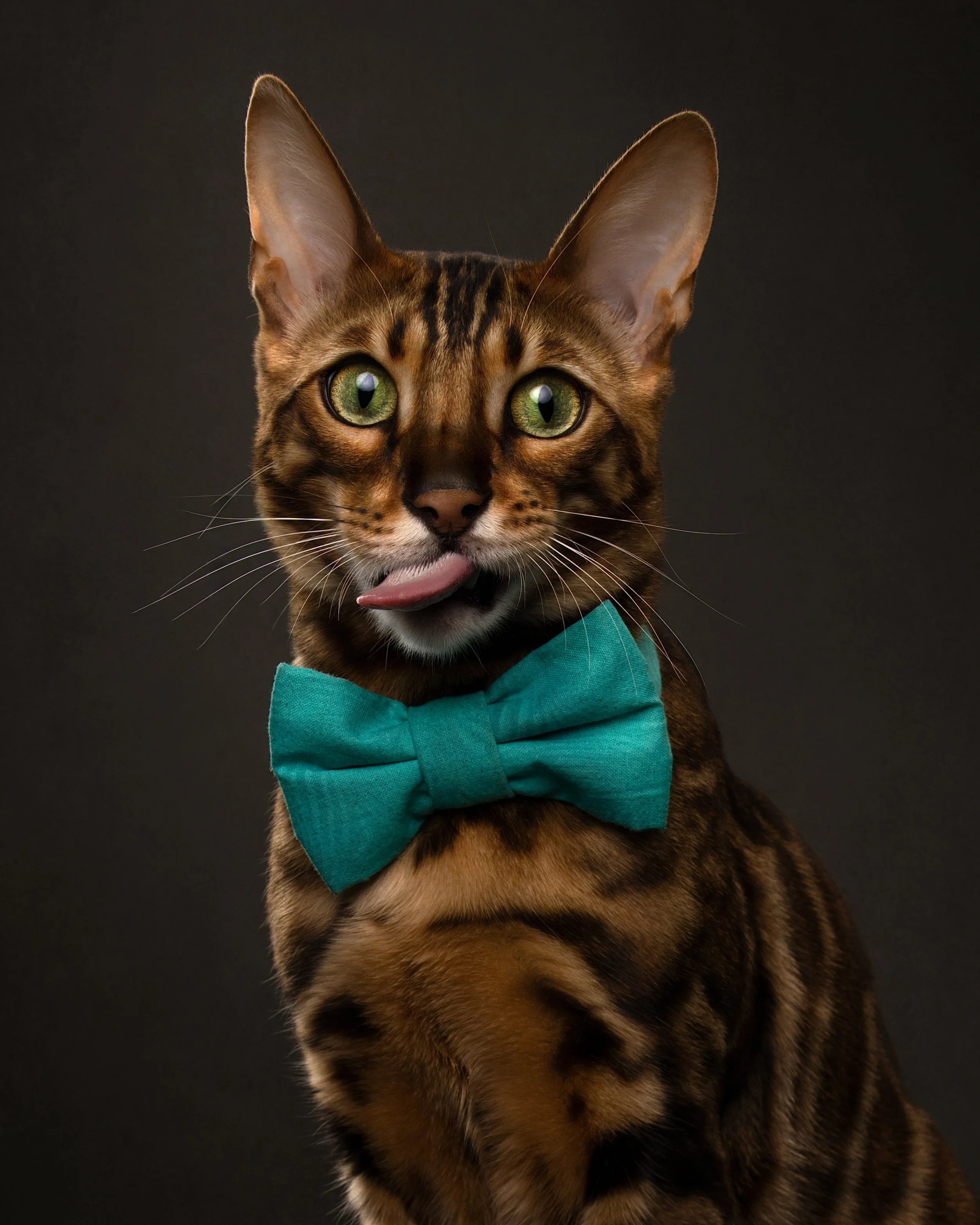
What about the studio lights and flash?
Professional studio lighting allows me to control the way light falls across a cat's face and body, bringing out the beautiful details in their coat, eyes and expression.
It's particularly useful with black cats, where poor lighting can easily turn a magnificent animal into a pair of floating eyes surrounded by darkness. Longhaired cats also benefit from carefully positioned light that separates the individual layers of fur and gives the photograph dimension.
But the cat's comfort always comes before the lighting setup.
Some cats aren't particularly bothered by studio equipment or flash, while others may be more sensitive to unfamiliar sounds or changes in their environment. I introduce things carefully and watch how the cat responds rather than assuming that because one cat was comfortable, the next one will be too.
If something is causing concern, we adjust our approach. We can change the setup, allow more time or reconsider whether that particular photograph is appropriate for the cat.
After all, there isn't much point creating beautiful lighting if the subject has decided they'd rather be anywhere else on the planet.
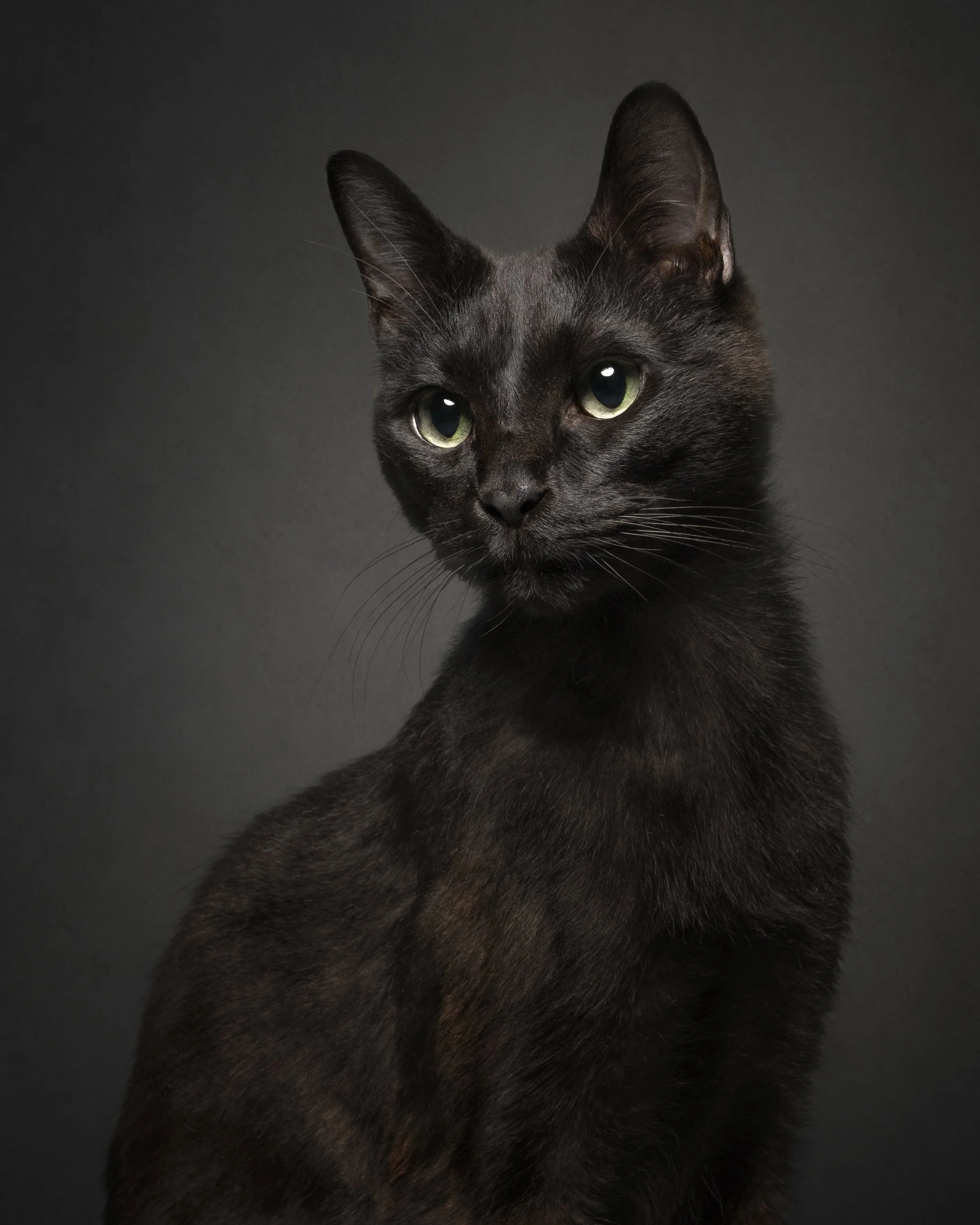
Onyx
Sometimes the cat chooses the pose
With dogs, I can often guide them into a particular position using rewards and an experienced animal handler. Cats generally require a little more flexibility.
Rather than trying to physically position a cat into an elaborate pose, I look for opportunities to use their natural movements and preferences.
A cat might enjoy sitting on a raised surface, investigating a particular object or stretching out somewhere they feel comfortable. If I know the type of photograph I want to create, I can arrange the environment to encourage the behaviour rather than attempting to force it.
This is where planning becomes particularly useful.
If I'm creating a more elaborate piece of artwork, I can think about the elements I need before the session and work out which parts can be photographed naturally. Not everything has to happen perfectly in one frame.
Sometimes the finished artwork is created from several photographs, allowing me to combine the best expressions, poses and details into one carefully constructed image.
Which brings me to one of my favourite examples.
Creating Cattitude
Cattitude is one of my favourite pieces of cat artwork, and it's a wonderful example of what can happen when you combine an understanding of feline behaviour with a little creative imagination.
The finished artwork has a very deliberate look, but creating something like this isn't about expecting a cat to understand the final concept. That's my responsibility.
I need to work out which expressions and movements will help tell the story, how to light the subject and how the photographs will eventually come together in the finished piece.
With creative composite artwork, the photography session is only one part of the process. The planning, image selection and editing are equally important, and they allow me to create something that goes beyond a traditional portrait while still preserving the animal's natural character.
Cattitude went on to become the highest scoring print at the 2025 NZIPP Iris Awards, which was a rather lovely outcome for a piece inspired by feline personality.
Although I'm fairly certain the cat would consider that recognition entirely appropriate.
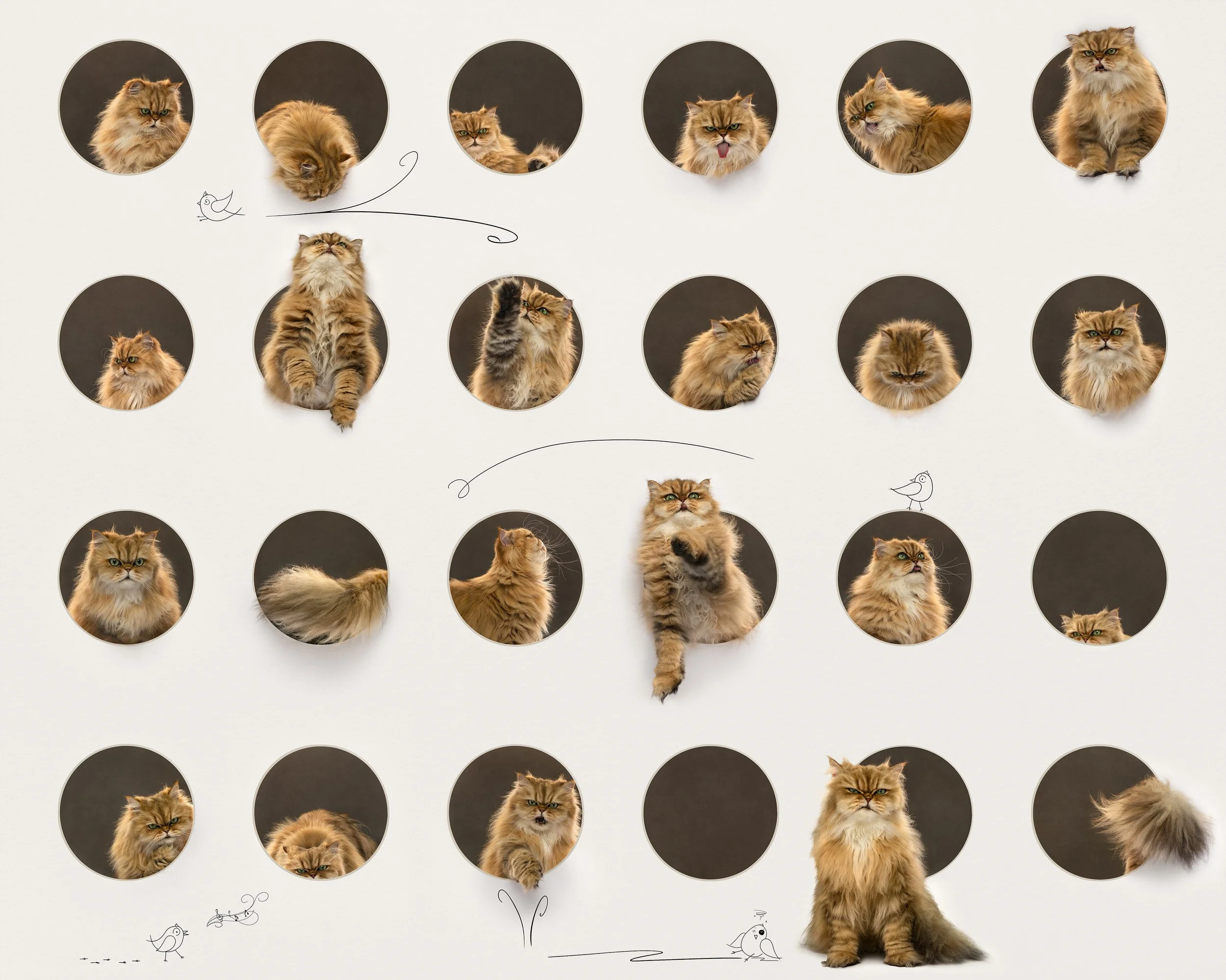
Moosha gave us everything for the making of Cattitude.
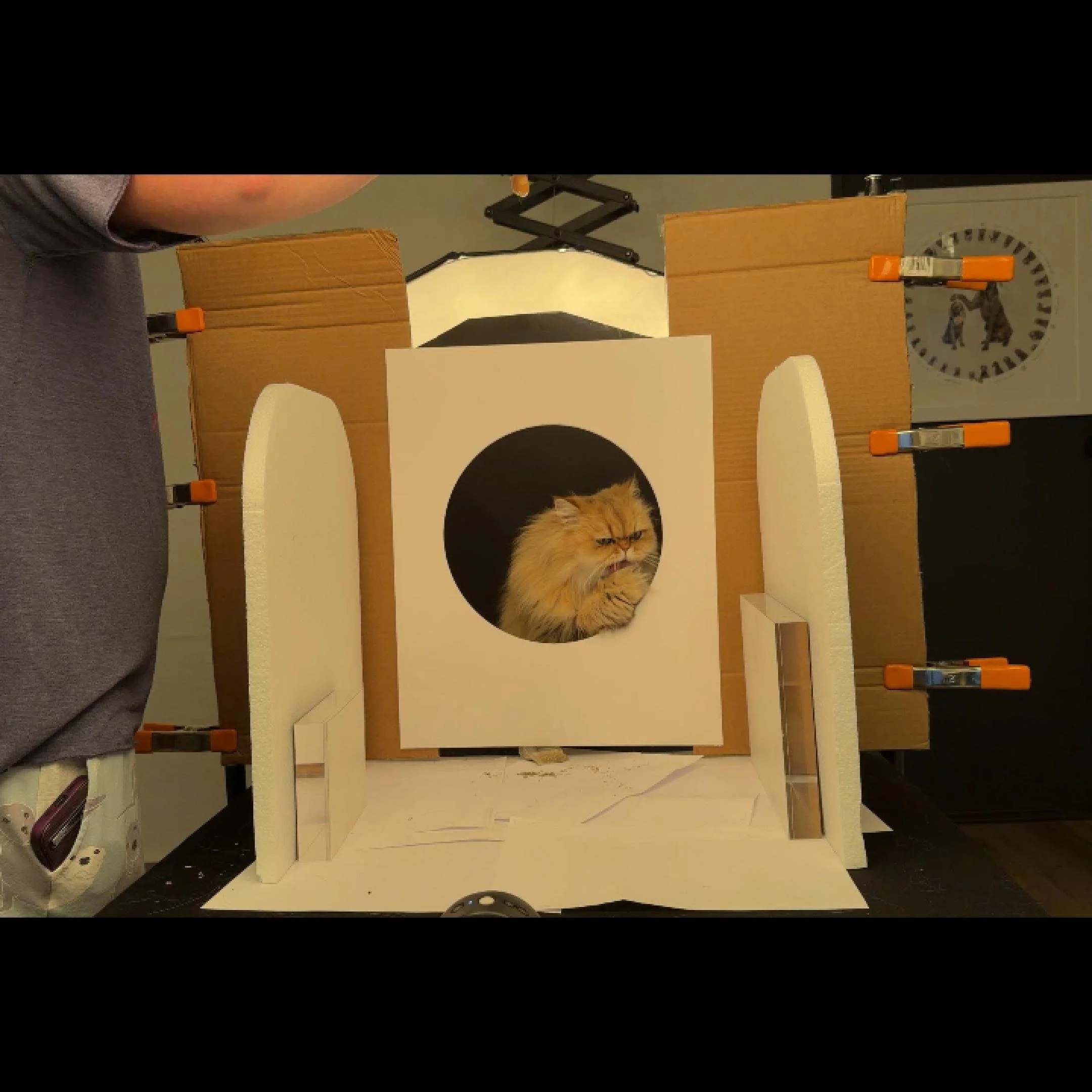
Behind the scenes shooting frames for the making of Cattitude.
Can shy or nervous cats be photographed?
Potentially, yes, but this is where we need to be particularly realistic about the individual animal.
Most cats simply need a little time to become comfortable somewhere unfamiliar. Others find travelling, handling or new environments genuinely distressing, and a studio photography session may not be suitable for them.
That's one of the reasons I want to meet your cat before committing to a photography session. It gives us a chance to discuss their behaviour, see how they respond to the studio and decide whether we can create a positive experience for them.
I don't believe in forcing a frightened animal to participate just because we have a particular photograph in mind.
If your cat needs time, we give them time. If they're more comfortable staying close to you, we work with that. And if it's clear that the experience isn't appropriate for them, we'll be upfront about it.
A beautiful photograph is never worth compromising an animal's wellbeing.
Every cat has a personality worth capturing
One of the things I love about photographing cats is how much personality they can communicate through the smallest changes in expression.
Some are curious and playful, while others have an extraordinary ability to look deeply unimpressed by absolutely everything. There are elegant cats, ridiculous cats, affectionate cats and cats who appear to be permanently judging the entire human race.
And sometimes all of those personalities belong to the same cat.
The photographs I want to create aren't about making every cat look sweet, perfectly behaved or conventionally beautiful. I want to capture the expressions and quirks that make their owners laugh and immediately recognise the animal they share their home with.
Sometimes that means a beautifully elegant portrait. Sometimes it's an expression that suggests the cat is contemplating world domination.
Both are equally worthy of a place on the wall.
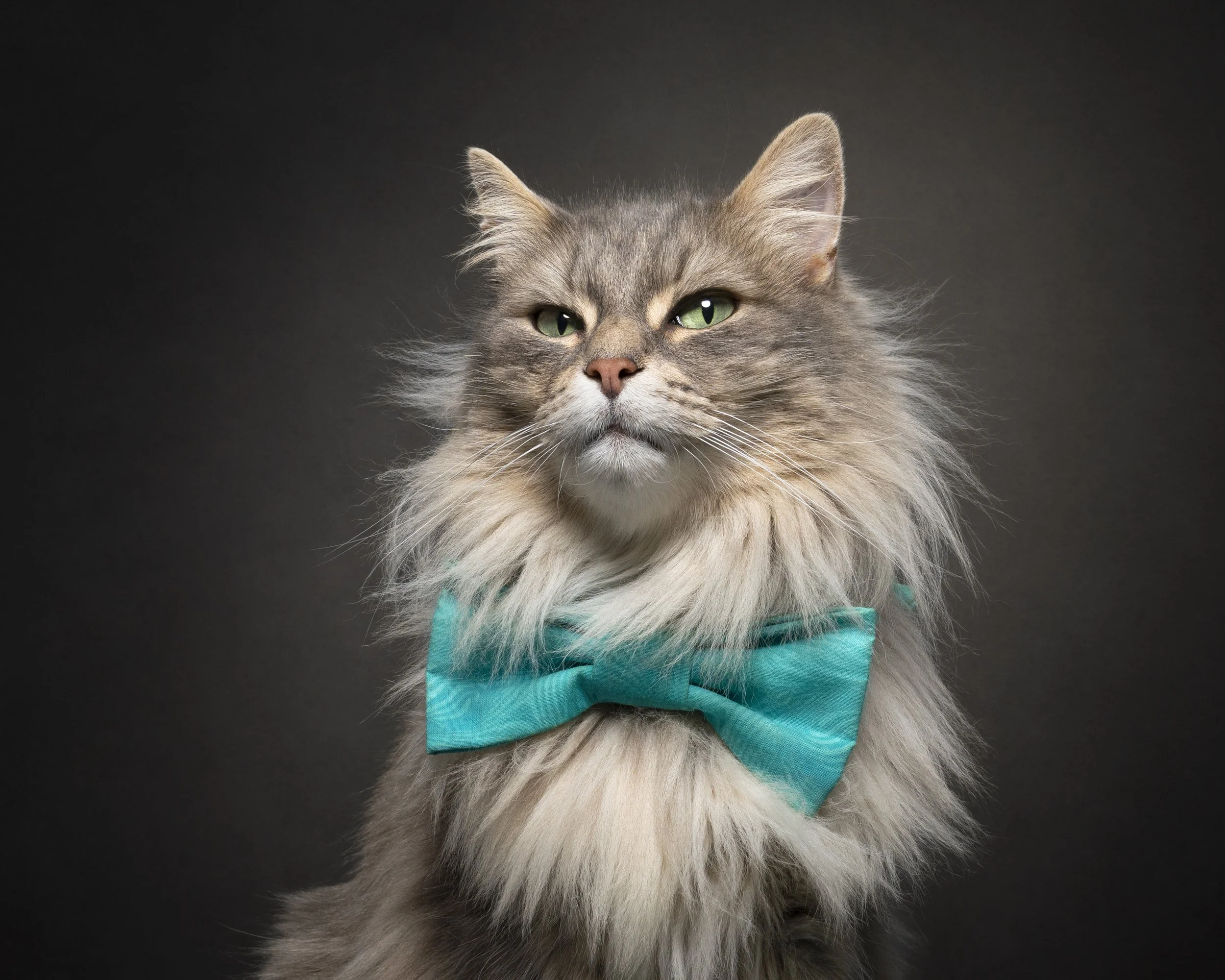
Jerry plans on taking over the world
Think your cat has what it takes?
Your cat doesn't need to know how to pose, perform tricks or behave like a dog to have beautiful professional portraits created.
What matters is understanding their personality, working with their natural behaviour and making sure they're comfortable throughout the experience.
At Frog Dog Studios in Brooklyn, Melbourne, we photograph cats as the wonderfully individual creatures they are. Every experience begins with an in studio consultation where we can meet your cat, talk about what makes them tick and discuss the artwork you'd love to create.
Your cat can decide whether I'm worthy of their attention.
I'll bring the camera.
I can’t wait to meet you!