“My dog would never cope with that.”
I hear this more often than you might think. Sometimes it’s because a dog is nervous around new people, unfamiliar places make them uncomfortable, or they’re sensitive to noises and new experiences. Then their owner looks through my gallery at dogs sitting beautifully under studio lights and understandably thinks there is absolutely no way their dog could do the same thing.
The thing is, they might not do it the same way. And that’s completely fine.
An anxious or nervous dog can absolutely have a professional photography session, but the experience needs to be adapted to the dog rather than expecting the dog to adapt to the experience.
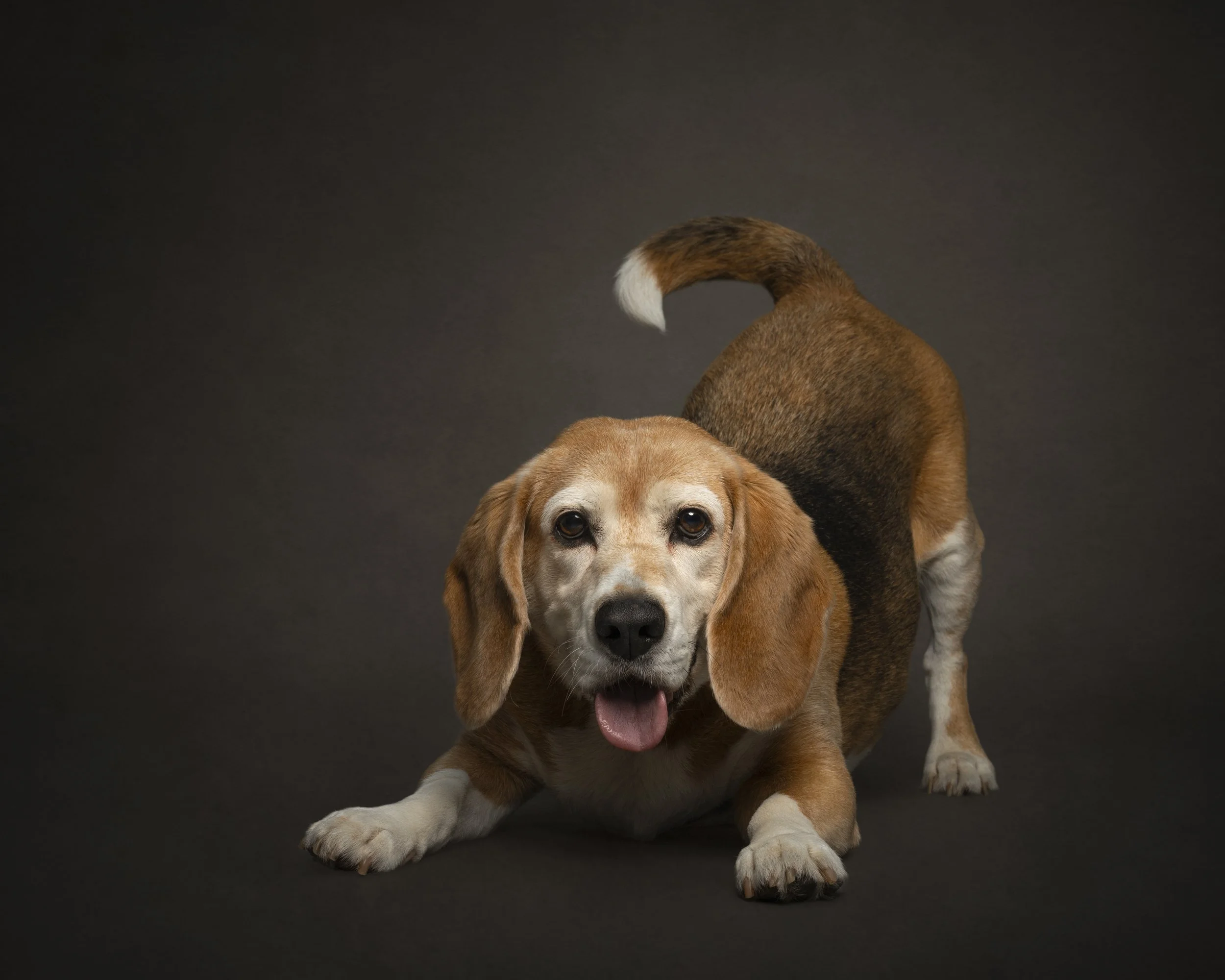
Simba started his session off with a lot of nervous energy. After spending spending some time together and being patient we were able to get this and many more gorgeous images for his Mum.
Can an anxious dog really have a studio photography session?
In most cases, yes. But the goal isn’t to make an anxious dog behave like a confident one. It’s to create an environment and a photography session that works for the individual dog standing in front of us.
I’ve spent more than 26 years working with animals across pet grooming, animal welfare, animal management and photography, and one of the most important things that experience has taught me is that you can’t simply tell an animal not to be frightened. You also can’t rush them through something they’re uncomfortable with just because there are photographs to take.
Instead, I’m looking at what the dog is telling me. Some nervous dogs settle remarkably quickly once they’ve had a chance to investigate the studio. Others need more time, more space or a completely different approach. That doesn’t make them difficult and it certainly doesn’t mean they can’t be photographed.
We’re photographing animals, not operating a production line. There has to be room for them to be individuals.
Fun Fact: In ten years I have only had one dog that I couldn’t get a single image of and had to send them home empty handed. I would much rather refund you than push the dog to its limits.
It starts before the photography session
This is one of the reasons I insist on meeting every pet before their photography session is booked. You and your dog will first come into Frog Dog Studios in Brooklyn for an in studio consultation, and for an anxious dog, that first visit can be particularly valuable.
There’s no expectation for them to perform. There isn’t a camera pointed at them and we’re not immediately asking them to stand somewhere strange while lights start flashing. They can have a sniff around, investigate the studio and take their time deciding what they think about the place.
It also gives me the opportunity to watch how they respond to the environment and to talk to you about what makes them anxious. You already know an enormous amount about your dog, so I want to know what you’ve noticed at home and in other situations. What worries them? What helps them settle? How do they normally respond to strangers? Is there anything we definitely shouldn’t do?
All of that information helps us make a plan before photography day rather than discovering everything when we’re already in the middle of it.
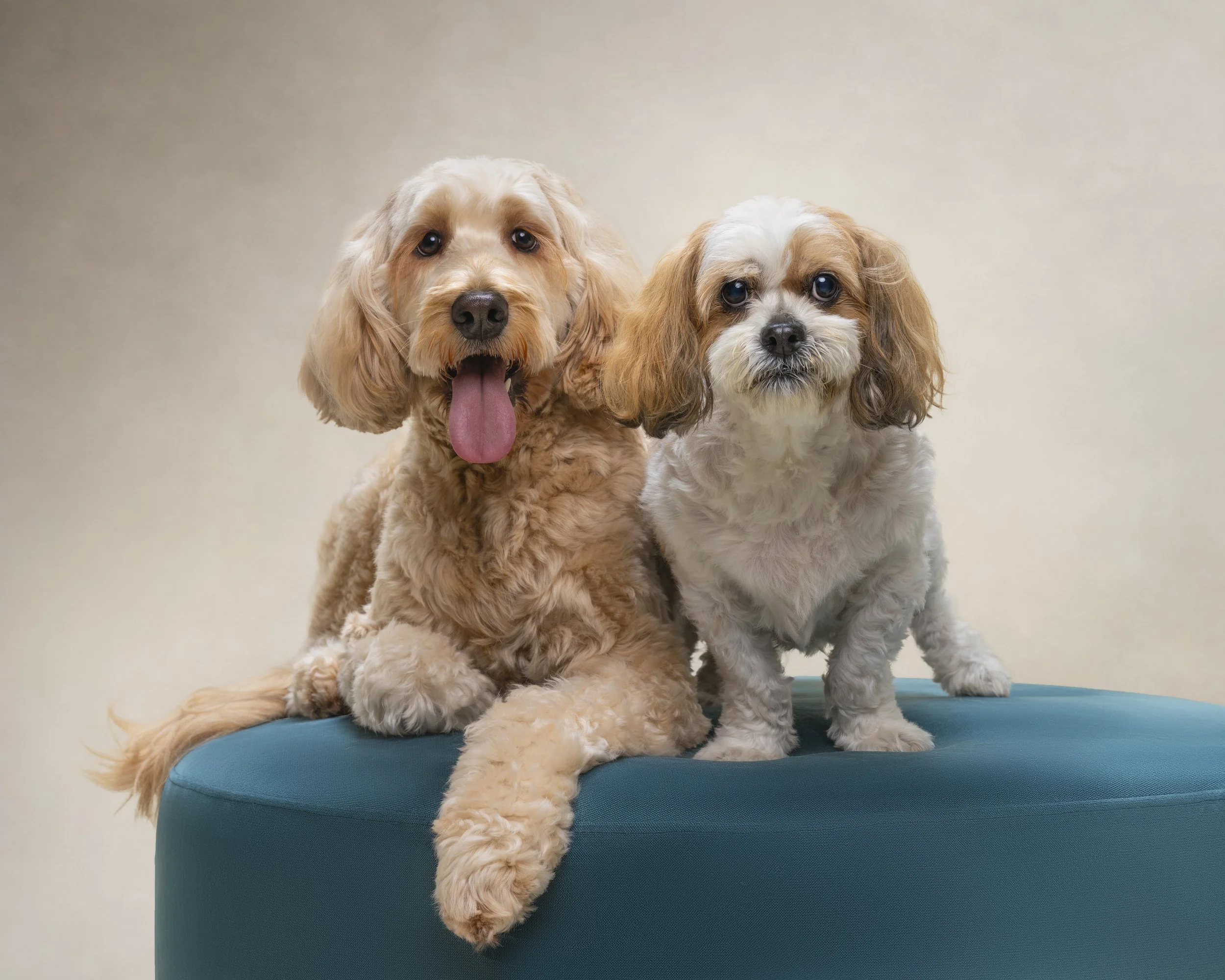
Poppy the big Golden Retriever X Poodle here was extremely anxious. This is a common personality trait with the oodle cross breeds. She showed extreme signs of being a stage five clinger to her human. After time and positioning the owner right next to her just out of frame, we were able to help her relax to pose with he brother Rusty.
Reading what your dog is telling us
Dogs are actually pretty good communicators. We humans aren’t always particularly good listeners.
An anxious dog isn’t necessarily the one barking, growling or desperately trying to leave. Sometimes the signs are much quieter. You might see changes in their posture or movement, avoidance, repeated lip licking, yawning, panting when they aren’t hot, ears moving back or a dog becoming unusually still. Other dogs become busier and more active when they’re uncomfortable.
None of those things should be looked at in isolation and declared THIS DOG IS FREAKING OUT. Body language needs context, and you need to look at the whole animal and what’s happening around them.
That’s where having years of experience working with animals becomes just as important to me as knowing how to use a camera. I don’t want your dog to have to reach the point of shouting NO THANK YOU VERY MUCH before I pay attention. The quieter conversations count too.

But what about the studio flash?
This is often one of the biggest concerns owners have, particularly if their dog is sensitive to noises or unfamiliar experiences. They walk into the studio, see the lights and immediately think, Fido is going to skip the country.
We don’t simply put a nervous dog into position and start firing the flash.
Instead, we can introduce it gradually using exactly the same principles of positive reinforcement that you might use when teaching a dog any other behaviour. At first, the flash might happen while your dog is simply hanging out in the studio and doing absolutely nothing.
The flash goes off and something good happens. Maybe that’s a treat, praise or whatever else we’ve discovered your dog values. Then we do it again.
We’re not waiting until the dog becomes frightened and then trying to convince them afterwards that everything is okay. We’re giving them the opportunity to learn that this unfamiliar thing isn’t a threat and, better still, it may predict something they quite like.
For many dogs, the mysterious flash eventually becomes less WHAT THE HELL WAS THAT? and more Oh, that thing means snacks.
Excellent. We have reached an agreement.
Positive reinforcement, not pressure
Positive reinforcement is a big part of how we work at Frog Dog Studios. Food is obviously an excellent negotiating tool for many dogs, but it isn’t the only option. Depending on the animal, we might use toys, praise, interaction or something else we’ve discovered they really enjoy.
Sometimes what a nervous dog needs most isn’t another treat at all. It’s space.
If a dog tells us they need a break, they get one. If something we’re trying isn’t working, we change it. If they’re becoming less comfortable rather than more comfortable, we pay attention to that instead of continuing just because it happens to be the photograph I had planned.
The goal is never to get the photograph at all costs. I want to create beautiful photographs without sacrificing the animal’s wellbeing to get them.
That’s a line I won’t cross.
What if my dog doesn’t like strangers?
They don’t have to fall madly in love with me. Devastating to my ego, obviously, but I’ll recover.
Some dogs simply don’t want a stranger immediately touching them, leaning over them or trying desperately to become their new best friend. One of the easiest ways to make a nervous dog more uncomfortable is to insist on an interaction they haven’t asked for, so sometimes the best thing I can do is leave them alone for a while.
They can watch me, have a sniff around and decide in their own time whether I’m worth investigating. I don’t need to force a relationship with them. What matters is that we’re building trust rather than demanding it.
The consultation helps here too. When your dog comes back for their photography session, I’m no longer a completely unfamiliar person in a completely unfamiliar place. We’ve already met and, hopefully, I’ve made a reasonable first impression.
If not, negotiations continue and I may still have cheese on my side.

Opi was one of my first clients all the way back in 2017. He was also the first good boy that I had t send home and get him to come back again the next week. He was way too stressed the first time he came to see me, so we spent about an hour together doing nothing but hanging out and eating treats. He came back the next week and absolutely nailed his shoot!
You’ll be there too
You’re not dropping your nervous dog at the studio door, waving goodbye and hoping for the best. You’ll be there throughout their photography session.
For most sessions, your job is to sit back and enjoy watching your pet become the star of the show while I work alongside an experienced animal handler. With a nervous dog, though, your presence can be particularly useful. If your dog feels safer with you nearby, we can absolutely work with that.
We might ask you to sit somewhere particular, offer some reassurance or simply be the familiar person in the room while we do our thing. On the other hand, some dogs settle beautifully and are quite happy to work with us while their person watches from the sidelines.
Again, there’s no formula we’re trying to squeeze every animal into.
What happens if my dog needs a break?
We have a break.
Pet photography doesn’t need to be one continuous hour of PERFORM FOR THE CAMERA PLEASE. Some dogs work beautifully for short periods and then need some time to reset. They can have a drink, spend a little time with you, wander around or investigate that fascinating corner of the studio for the fourteenth time.
Then we see whether they’re ready to continue.
One of the advantages of working this way is that I’m watching the dog rather than the clock. Taking five or ten minutes to let an animal settle can ultimately get us much further than spending those same ten minutes repeatedly asking them to do something they’re no longer comfortable doing.
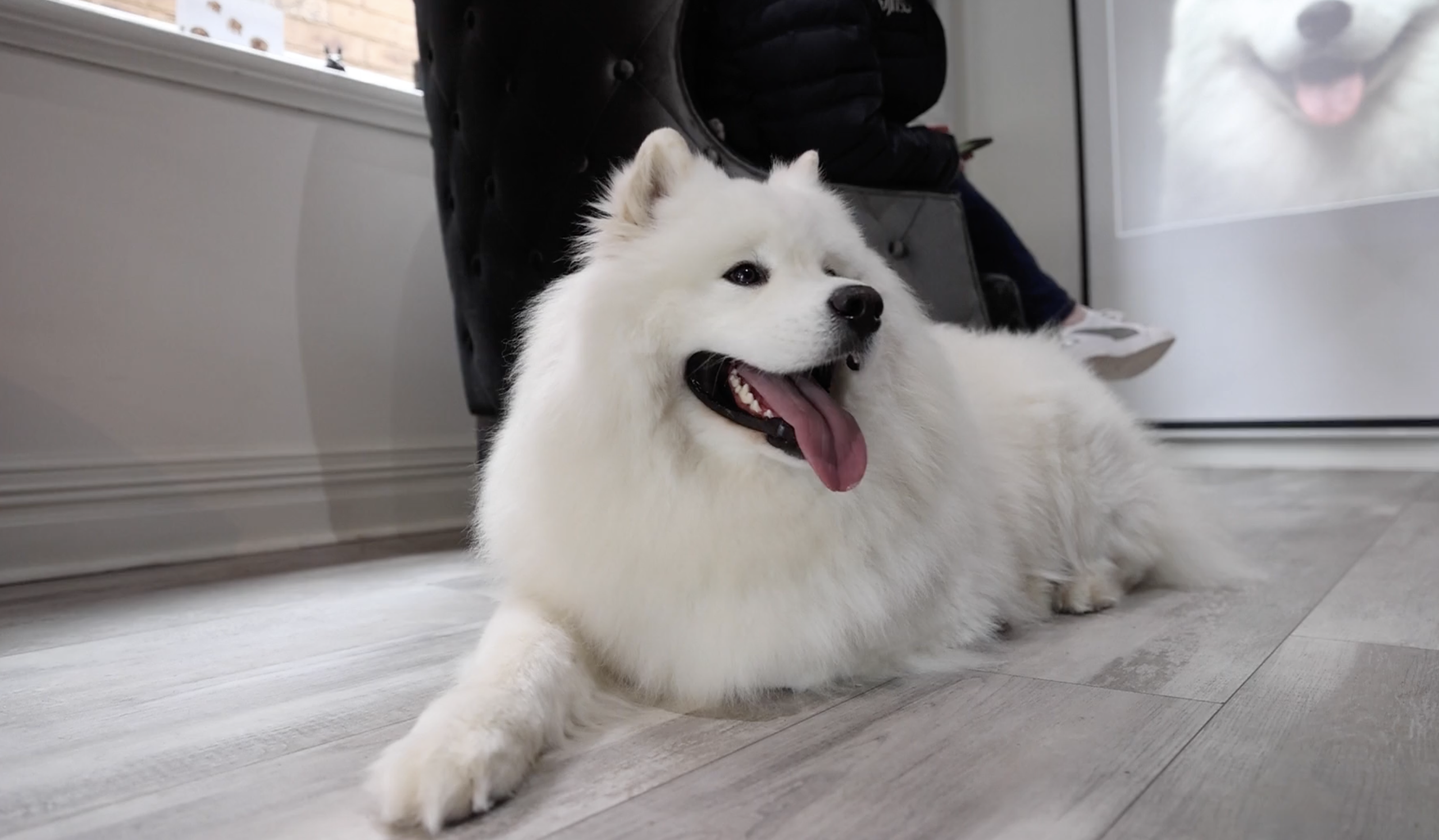
Ziggy does a relax.
And what if they’re just not comfortable on the day?
Animals can have bad days too.
Even with preparation, your dog may arrive feeling more anxious than usual. Something might have happened before you left home, the trip to the studio may have unsettled them or they might simply tell us that today isn’t the day.
If that happens, we listen.
We can slow things down, change what we’re doing or stop if that’s what your dog needs. There is no photograph important enough to justify pushing an animal beyond what they’re comfortable with.
No ifs, ands or mutts.
Will my dog look anxious in the photographs?
This is an interesting question because what you eventually see hanging on your wall is a tiny fraction of a second.
Your dog doesn’t need to spend the entire photography session looking like they’ve just returned from a wellness retreat. I’m looking for the moments when they’re comfortable, engaged and being themselves. That might be when their ears suddenly come forward, they give me a little head tilt, something sparks their curiosity or they glance towards you with an expression you recognise immediately.
Those moments can still happen in a session where we’ve needed to take things slowly. Part of my job is recognising when they’re coming and being ready to capture them when they do.
Sometimes the beautifully relaxed portrait you see at the end represents only a few seconds of absolute perfection amongst a much slower, carefully managed session.
And a few seconds is all I need.

Success might look a little different for your dog
If you share your life with an anxious dog, this is probably the most important thing I want you to take away from this.
A successful photography session doesn’t mean recreating every photograph you’ve seen in my gallery.
Your dog’s session will be built around your dog.
Maybe there’s a particular setup they don’t feel comfortable with. We don’t use it. Perhaps we create fewer different poses but get several beautiful variations of something they’re completely comfortable doing. Maybe the photograph you eventually fall in love with isn’t the elaborate one we had imagined at all.
That’s okay.
I would much rather create something beautiful within your dog’s comfort zone than tick off a list of photographs they hated making.
Your nervous dog isn’t a problem to solve
They’re simply an individual who needs us to listen a little more carefully.
If you’ve avoided professional pet photography because you’re worried your dog is too anxious, nervous or sensitive for a studio environment, don’t rule them out before we’ve even met them.
The first thing we’ll do is bring them into Frog Dog Studios for an in studio consultation. They can investigate the space, meet me and take everything in without the pressure of being photographed. We can talk about what worries you, what you already know about your dog and how we might approach their session.
Then we can decide what’s right for them.
And if they spend the first ten minutes pretending I don’t exist?
That’s okay too. I’ve got a th
I can’t wait to meet you!